
Kube-OVN brings NSX-style networking to SUSE Virtualization (Harvester): virtual private clouds (VPCs), subnets with access control lists, peering, and NAT. I wanted to go one step further and give VMs on different clusters a shared, routed network, the way a multi-site NSX deployment would.
Kube-OVN can do that with OVN interconnection (OVN-IC). I built it across four lab clusters, and VMs on three of them now reach each other in 1–2 ms. Along the way I learned where its limits are, worked around a routing quirk in Kube-OVN 1.16.2, and saw its data plane keep VMs connected through a control-plane recovery.
A caveat up front: SUSE Virtualization 1.9 lists multi-cluster networking as not supported, and nothing about OVN-IC appears in its UI. Everything here is a lab experiment. VPCs, peering, subnet ACLs and NAT on a single cluster are supported; the cross-cluster part is not.
What I built
Four clusters, each an OVN availability zone (AZ), all on SUSE Virtualization 1.9.0
with Kube-OVN 1.16.2 (installed by the kubeovn-operator add-on) and VXLAN
encapsulation. Kube-OVN runs as a secondary network, so it carries VM NICs while pods
keep the default Canal network.
| AZ | Nodes | Role |
|---|---|---|
hq | 3 | hosts the OVN-IC database |
ai | 1 | GPU cluster, powered on part-time |
edge | 1 | always-on single node |
dr | 3 | disaster-recovery cluster on a separate underlay subnet |
| Piece | Status |
|---|---|
Shared backbone network, VM to VM across hq, ai and edge | working |
dr joined to the interconnection control plane | working |
dr data plane | next: needs a return route on its underlay network |
| Tenant VPCs per site, including overlapping CIDRs and VPC peering | working |
| Micro-segmentation with subnet ACLs | working |
| Stretched layer 2 between two sites (bridge network, dual-NIC VMs) | working |
Outbound internet through subnet natOutgoing | working |
| VPC NAT gateway with elastic IPs | next: needs a dedicated NIC |
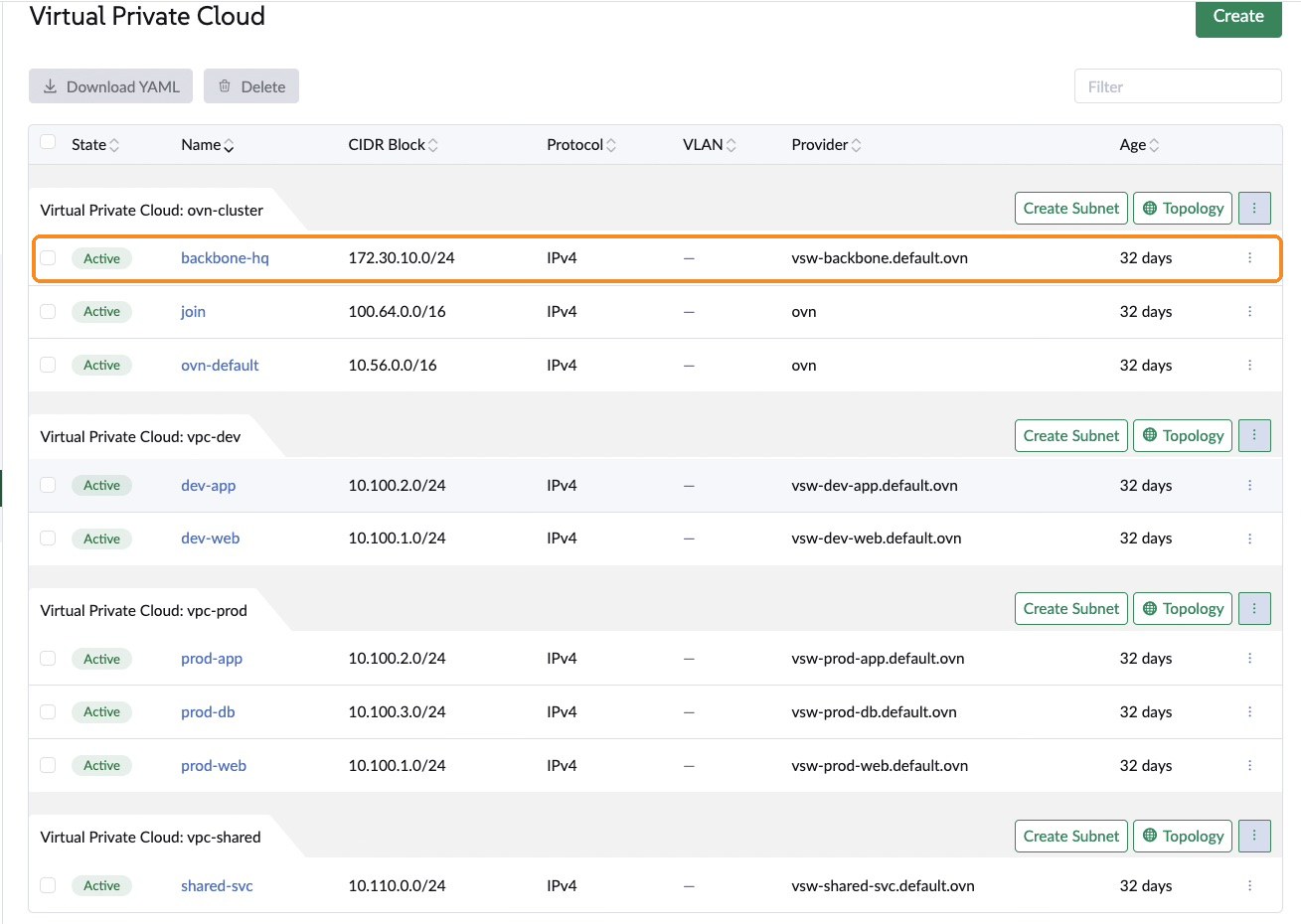
This is the hq site in the SUSE Virtualization UI. Its default VPC (ovn-cluster)
holds the cross-site backbone-hq subnet, outlined, while the tenant VPCs reuse the
same 10.100.x ranges without conflict:
Limits to know before you start
- OVN-IC only interconnects the default VPC. Kube-OVN patches every transit
switch into the default cluster router (
ovn-cluster), and the VPC resource has no interconnection setting, so custom VPCs stay local to their cluster (I confirmed this in testing). - Custom VPCs can’t peer with the default VPC. SUSE Virtualization’s docs say so explicitly, which closes the obvious bridge between tenant VPCs and the interconnected network.
- Overlay networks can only be created on the
mgmtcluster network. natOutgoingisn’t in the UI. It defaults tofalseand must be set in YAML.
So the design is: a backbone-<az> subnet in each cluster’s default VPC carries
cross-site traffic, and tenant VPCs stay local to their site.
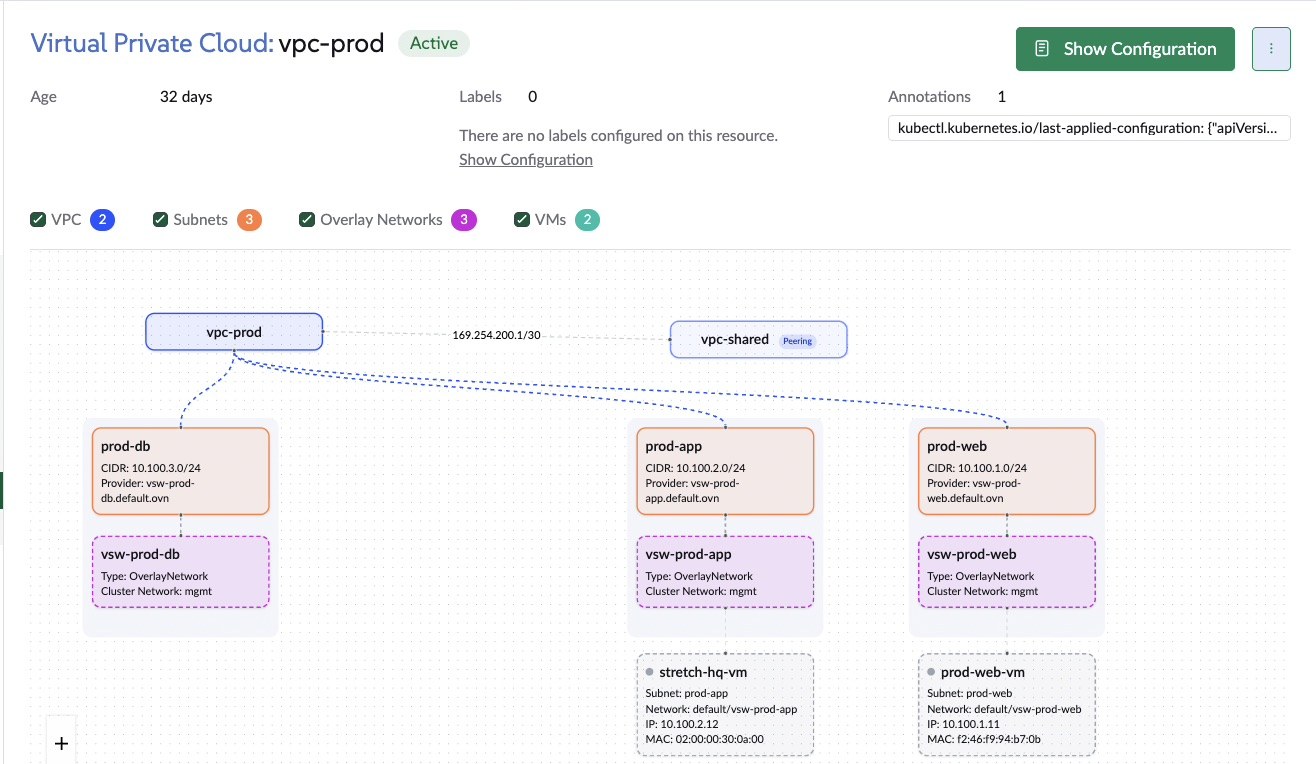
Within a site, the VPC topology view makes that local design easy to follow. Here
vpc-prod has database, application and web tiers, each with its own subnet and
overlay network, and peers with vpc-shared for common services:
How OVN-IC fits together
Each cluster keeps its own OVN databases. OVN-IC adds one more pair of databases, the
IC northbound and southbound DBs, which all AZs share. Through them, every AZ
attaches its cluster router to a common transit switch (ts, 169.254.100.0/24)
via one or more gateway nodes, and traffic between AZs crosses that switch over
VXLAN tunnels.
Step 1: Enable interconnection in each cluster
Patch Kube-OVN’s Configuration resource, not just the add-on. Its field lives under
components:
kubectl patch configurations.kubeovn.io kubeovn -n kube-system --type=merge \
  -p '{"spec":{"components":{"enableIC":true}}}'
About three minutes later, the interconnection controller appears.
Step 2: Run the IC database
I run the IC database on hq as a three-member raft cluster, using Kube-OVN’s
install-ic-server.sh from the release-1.16 branch:
TS_NUM=1 bash install-ic-server.sh
It places members on nodes labelled kube-ovn/role=master, so label three nodes
first. Only the raft leader answers database commands; followers report Ready but
reject requests.
Step 3: Turn on VXLAN mode before anything joins
OVN-IC assigns transit-switch tunnel keys from the Geneve range unless you opt into VXLAN mode. With VXLAN encapsulation, each AZ then computes its own key and packets disappear silently. Set it on the IC northbound leader:
ovn-ic-nbctl set ic_nb_global . options:vxlan_mode=true
Afterwards, every AZ’s transit switch should show tunnel_key : 1025 and
requested-tnl-key="1025".
Step 4: Point each cluster at the IC database
One ConfigMap per cluster. az-name must be unique, and gw-nodes lists the nodes
that carry traffic to the transit switch:
apiVersion: v1
kind: ConfigMap
metadata:
  name: ovn-ic-config
  namespace: kube-system
data:
  enable-ic: "true"
  az-name: "hq"
  ic-db-host: "<ic-db-node-1>,<ic-db-node-2>,<ic-db-node-3>"
  ic-nb-port: "6645"
  ic-sb-port: "6646"
  gw-nodes: "<gateway-node-1>,<gateway-node-2>"
  auto-route: "false"
Treat it as immutable: to change it, delete it and apply it again.
Step 5: Create a backbone subnet in each site
Each site gets a non-overlapping /24 in the default VPC, attached to VMs through an
overlay network definition:
apiVersion: k8s.cni.cncf.io/v1
kind: NetworkAttachmentDefinition
metadata:
  name: vsw-backbone
  namespace: default
  labels:
    network.harvesterhci.io/type: OverlayNetwork
spec:
  config: '{"cniVersion":"0.3.1","name":"vsw-backbone","type":"kube-ovn","provider":"vsw-backbone.default.ovn","server_socket":"/run/openvswitch/kube-ovn-daemon.sock"}'
---
apiVersion: kubeovn.io/v1
kind: Subnet
metadata:
  name: backbone-hq            # 172.30.10/20/30/40.0/24 for hq/ai/edge/dr
spec:
  vpc: ovn-cluster
  protocol: IPv4
  provider: vsw-backbone.default.ovn
  cidrBlock: 172.30.10.0/24
  gateway: 172.30.10.1
  enableDHCP: true
  natOutgoing: false           # SNAT would break the return path across sites
Step 6: Route between sites by hand
With auto-route: "true", OVN-IC exchanges routes for you. In my lab, three clusters
share the same default pod subnet, and in Kube-OVN 1.16.2 the overlap filter didn’t
exclude those routes (it matches an empty route marker, while the real value is a
UUID), so they showed up as equal-cost routes in two AZs. Explicit routing sidesteps
that and gives full control over the paths.
Instead, each site gets explicit routes in its default VPC: a static route per remote
backbone through that AZ’s transit-switch address, plus a priority-31000 allow
policy. Without the policy, Kube-OVN’s own priority-29000 node-egress rule pulls the
traffic onto the join network. For hq:
{"spec":{"staticRoutes":[
 {"cidr":"172.30.20.0/24","nextHopIP":"169.254.100.23","policy":"policyDst"},
 {"cidr":"172.30.30.0/24","nextHopIP":"169.254.100.52","policy":"policyDst"},
 {"cidr":"172.30.40.0/24","nextHopIP":"169.254.100.34","policy":"policyDst"}
],"policyRoutes":[
 {"action":"allow","match":"ip4.dst == 172.30.20.0/24","priority":31000},
 {"action":"allow","match":"ip4.dst == 172.30.30.0/24","priority":31000},
 {"action":"allow","match":"ip4.dst == 172.30.40.0/24","priority":31000}
]}}
kubectl patch vpc ovn-cluster --type=merge --patch-file=ic-routes-hq.json
kubectl ko nbctl lr-route-list ovn-cluster     # verify
A merge patch replaces the whole route list, so always apply the complete file. Take
the next-hop addresses from ovn-ic-sbctl show; they belong to each AZ’s gateway
port on the transit switch.
Results
Pings between sites, all with 0% loss:
| Path | Round trip |
|---|---|
hq ↔ edge | ~1.0 ms (0.55 ms after the October rebuild) |
hq ↔ ai | ~1.9 ms |
ai ↔ edge | ~2.2 ms |
VMs attached to the backbone on hq, ai and edge reach each other directly.
dr already participates in the interconnection control plane; its data plane comes
up once its underlay network gets a return route.
Gotchas
- Keep routes in step with transit addresses. Each AZ’s address on the transit
switch can change when the IC database is rebuilt, and static routes must follow.
After any IC change, regenerate the routes from
ovn-ic-sbctl show; a small script that applies all four files keeps the sites consistent. - Test the data plane, not just the join. An AZ can register correctly in the IC database before its tunnels pass traffic (VXLAN mode is the usual culprit), so confirm with real pings.
- Warm up before measuring. After a rebuild, the first packet in each direction is dropped while OVN learns MAC bindings.
- Don’t copy your pod network range. On one cluster, Kube-OVN’s default subnet used
the same CIDR as Canal with outbound NAT on, which masqueraded cross-node traffic and
interfered with Kubernetes network policies for other workloads. Renumbering fixed
it, in this order: add-on, then the
Configurationresource, then the subnet itself.
Resilience: the data plane kept running
My lab is hard on its systems. Nodes get power-cycled abruptly, reflashed and rebuilt
far more often than any production cluster would allow. On September 24, one hq node
came back from a rebuild without its local OVN state (/etc/origin/ovn), rejoined
under new raft server IDs, and left two control-plane databases without a quorum:
- Its own OVN databases, which I had running as a two-member raft.
- Shared IC database, whose member list now held two stale entries.
What impressed me is what happened next: nothing visible. Every running VM kept
talking across sites on the flows OVN had already programmed into each host. Only new
changes waited: a freshly started VM sat in Starting, and the rebuilt node’s CNI pod
retried until the control plane came back. I spotted it on October 4.
Recovery was quick because Kube-OVN rebuilds its northbound database from Kubernetes
resources. For each raft cluster, I moved the database files aside and restarted the
members together, re-enabled VXLAN mode on the new IC leader, and regenerated the
routes for the new transit addresses. Everything came back with 0% loss at 0.55 ms
between hq and edge.
What I’d carry into any deployment:
- Run three raft members (or one), never two. Two members need each other to elect a leader, so they can’t ride out the loss of either.
- Check raft health after node maintenance, not just pod readiness:
ovn-appctl -t /var/run/ovn/ovnnb_db.ctl cluster/status OVN_Northboundinside eachovn-centralpod (andovn_ic_nb_db.ctl/OVN_IC_Northboundfor the IC database). - Monitor the control plane separately from traffic. OVN’s data plane is resilient enough that VMs alone won’t tell you when the control plane needs attention.
Takeaways
- OVN-IC gives SUSE Virtualization a real routed network across clusters at 1–2 ms, using only open-source pieces. It’s unsupported today, so treat it as a lab technique.
- Design around its limits: only the default VPC interconnects, so keep tenant VPCs local and use a dedicated backbone subnet for cross-site traffic.
- Set VXLAN mode before the first AZ joins, use explicit routes on Kube-OVN 1.16.2, and regenerate them after every IC change.
- Run three raft members. OVN’s data plane rides out control-plane trouble; give the control plane the same resilience.
What’s next
- Add a third member to the two-member OVN database cluster.
- Fix the
drunderlay route so its data plane comes up. - Give a site a dedicated NIC for a VPC NAT gateway with elastic IPs.