NVIDIA AI Cluster Runtime (AICR) captures known-good combinations of GPU drivers, operators and system settings as version-locked recipes, then turns a recipe into a deployable bundle. Until now, those bundles targeted Helm, Argo CD, Flux, Helmfile and Terraform.
AICR v1.1.0, released today, adds two features I contributed, both named in the release’s opening line:
- A Rancher Fleet deployer, so Rancher users can roll an NVIDIA-validated GPU stack out to many clusters with Fleet (aicr#3043).
- SUSE Linux Enterprise Server on RKE2, including SUSE’s precompiled NVIDIA driver containers (aicr#3040).
The Fleet deployer
aicr bundle --recipe recipe.yaml --deployer fleet \
  --repo https://github.com/my-org/gpu-fleet.git \
  --output ./bundles
Fleet is Rancher’s GitOps engine: it watches a Git repository, or a set of HelmOp objects, and installs what it finds onto every matching downstream cluster. AICR’s deployer supports both styles:
| Mode | Flag | Output | Best for |
|---|---|---|---|
| GitRepo (default) | --fleet-mode gitrepo | one fleet.yaml per component folder, plus a root gitrepo.yaml | committing the bundle to Git |
| HelmOp | --fleet-mode helmop | a single helmops.yaml, one HelmOp per component, values inlined | applying directly, large charts |
fleet/ (--fleet-mode gitrepo)        fleet/ (--fleet-mode helmop)
  001-cert-manager/                    001-cert-manager/
    values.yaml ...                    002-nfd/
    fleet.yaml                         helmops.yaml
    .fleetignore                       recipe.yaml
  002-nfd/                             bundle-info.yaml
  gitrepo.yaml                         checksums.txt
  recipe.yaml                          README.md
  bundle-info.yaml
  checksums.txt
  README.md
How it fits Fleet’s model:
- Installation order: each component’s bundle
dependsOnthe previous one, so Fleet installs strictly in recipe order and starts each component only after its predecessor isReady. - Opt-in targeting: clusters receive the stack only when labeled
aicr.nvidia.com/bundle=<app-name>. Nothing lands on a cluster by accident. - Workspaces:
--fleet-namespacedefaults tofleet-default, which targets downstream clusters; usefleet-localfor Rancher’s own cluster. - Install-time values:
--dynamicworks through per-foldercluster-values.yaml. - Upgrade checks:
aicr upgrade-check --from cluster --deployer fleetreads the Helm releases that Fleet’s agent wrote on the downstream cluster.
Why there are two modes
I found this one the hard way while testing against a real Rancher cluster. In GitRepo
mode, Fleet embeds each Helm chart in a Bundle object. kube-prometheus-stack compresses
to about 1.4 MB, which deploys fine from a GitRepo but is rejected when fleet apply
posts it through Rancher’s 1 MiB request-body limit. HelmOps reference charts instead
of embedding them, so chart size stops mattering. In exchange, HelmOp mode
can’t carry local charts or raw manifests, and it needs Fleet v0.13 or later.
SLES on RKE2
aicr recipe --service rke2 --os sles --accelerator h100 --intent training -o recipe.yaml
SLES support adds --os sles, an os-sles mixin, and a shared rke2-sles base that
matches SUSE’s documented GPU Operator setup on RKE2:
- SUSE’s precompiled NVIDIA driver containers from the SUSE registry, instead of compiling the driver on every node.
- The NVIDIA Container Toolkit pointed at RKE2’s own containerd socket.
I validated it on three Ampere Altra nodes running SLES 16 and RKE2 with NVIDIA A2 GPUs. Note that AICR marks RKE2 recipes as Preview: an early-adopter path, not yet fully qualified for production support.
NVSentinel and GPU Operator fixes
Deploying AICR’s full stack on RKE2 surfaced a few problems in neighboring projects, which I fixed upstream too:
- NVSentinel#1949 (merged):
NVSentinel’s metadata collector couldn’t start on clusters where the GPU Operator runs
its NRI plugin, because that mode removes the
nvidiaruntime class it relied on. The collector can now request GPU access through a CDI device annotation instead. AICR v1.1.0 already builds on it: a maintainer follow-up (aicr#3254) turns NRI mode on in RKE2 recipes. - NVSentinel#1956 (merged): NIC topology parsing failed on single-GPU nodes, such as my A2 servers.
- gpu-operator#2988 (merged): the GPU Operator now reports which operands are blocking a cluster’s readiness, instead of just “not ready”.
Still in review:
- NVSentinel#1958: a guide for deploying NVSentinel on SUSE Linux Enterprise and RKE2.
- NVSentinel#1959: SELinux options for enforcing nodes.
- NVSentinel#1957: a design proposal for host diagnostics that don’t depend on a cloud provider.
What’s next
On the Rancher side, I’ve proposed an importer for SUSE AI Factory that turns AICR bundles into AI Factory Blueprints (aif#296), so an NVIDIA-validated GPU stack becomes a one-click install from the Rancher UI.
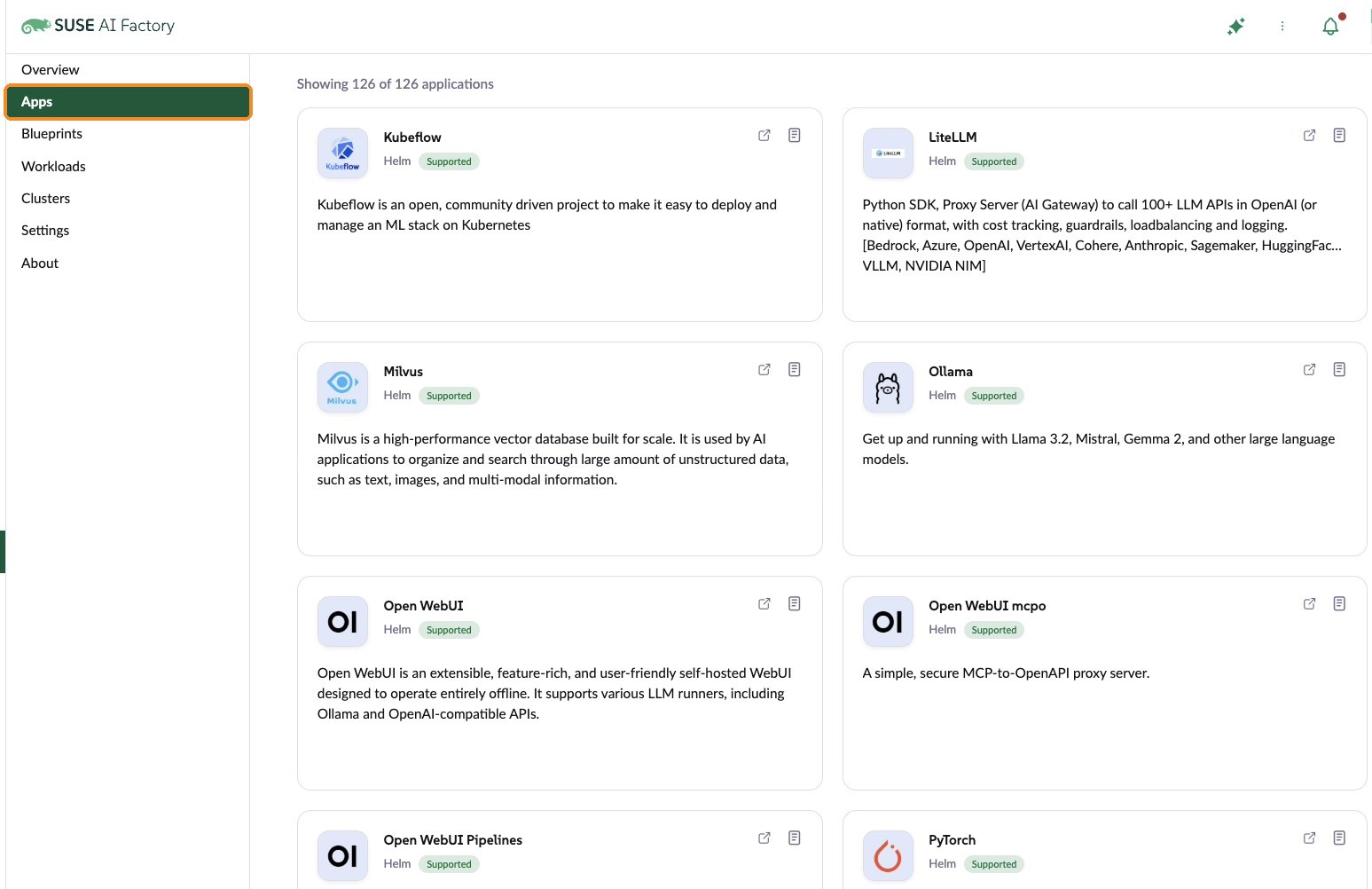
SUSE AI Factory already offers a catalog of AI applications in Rancher, from Kubeflow and Milvus to Ollama and Open WebUI, under its Apps menu. Blueprints build on that catalog by grouping apps into a stack, which is where an imported AICR GPU stack would live:
 It’s in review, along with a
change that orders Blueprint components the same way the Fleet deployer does
(aif#298).
Thanks
Thank you to the AICR maintainers, especially Mark Chmarny, Yuan Chen and Brian Lockwood, whose detailed reviews made the Fleet deployer much better than my first draft. Thanks also to Lalit Adithya for NVSentinel and Rahul Sharma for the GPU Operator.